Welcome to our May edition of the Hoschke Family Newsletter. Hope everyone is keeping warm as we head into winter. This month we have some great stories and photos to share and would like to invite everyone to join our new facebook group too!
Our article of the month has some funny sections, like family house parties where only men were invited to the house if they had a lot of daughters to ensure some good prospects! And don’t miss the sly grog story at the end if you are a rum drinker! Orara Valley locals have always known how to have a good time and the Orara Valley Hall continues to be the centre of the community to this day.
🪵 Early Days at Orara
🧑🧑🧒🧒 Cousin Chart
🏘️ Facebook Group
📆 A Decade in Time 1940 – 1949
Article of the Month – Early Days at Orara
Notes about the early days at Orara and Karangi
These are excerpts from a document describing life in the area in the early 1900’s. The writer is unknown.
Original settlers – Timber and Trees
Their chief aim was to fall the timber and plant grass to sustain their cattle and horses.
The method here was to fall the smaller timber, and ring-bark the larger trees, who gradually died. Then there was the everlasting job of brushing the undergrowth.
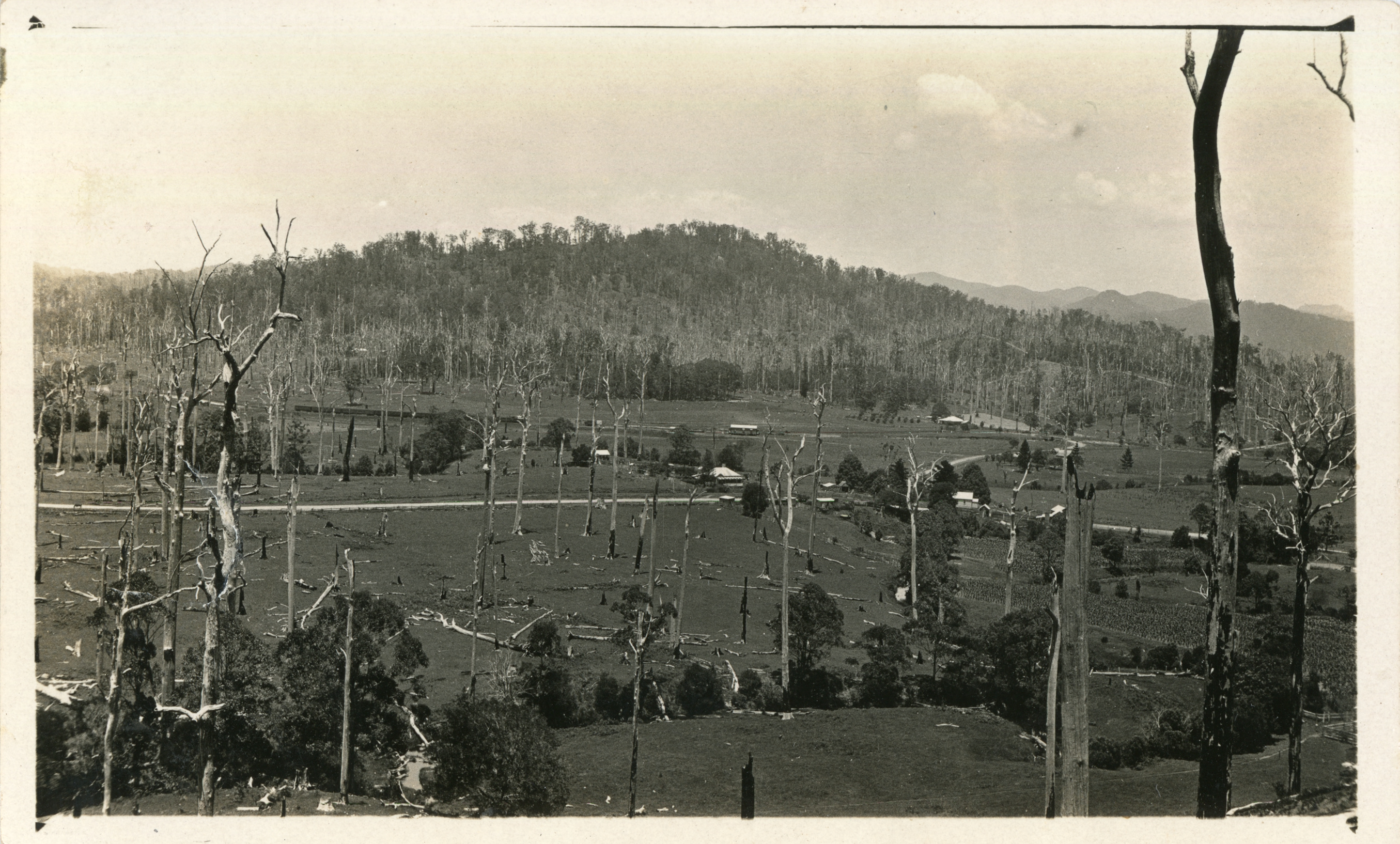
My first, memory of Karangi was grassed paddocks, with thousands of large dead trees, like tombstones in a cemetery. As time went on, these old trees rotted, and when we had a storm, the trees would fall over the roads and telephone lines, cutting off all communication.
On top of Mt. Coramba was a clump of very large pine trees. When we visited there, there were still quite a number, but most had been felled. The area was then inaccessible by bullocks. The method used to get the timber, was to fall it down the steep southern side, hoping it would shoot far enough down the mountain. Most of it did, but there were quite a lot of these giant trees caught in crevices on the mountainside and left to rot.
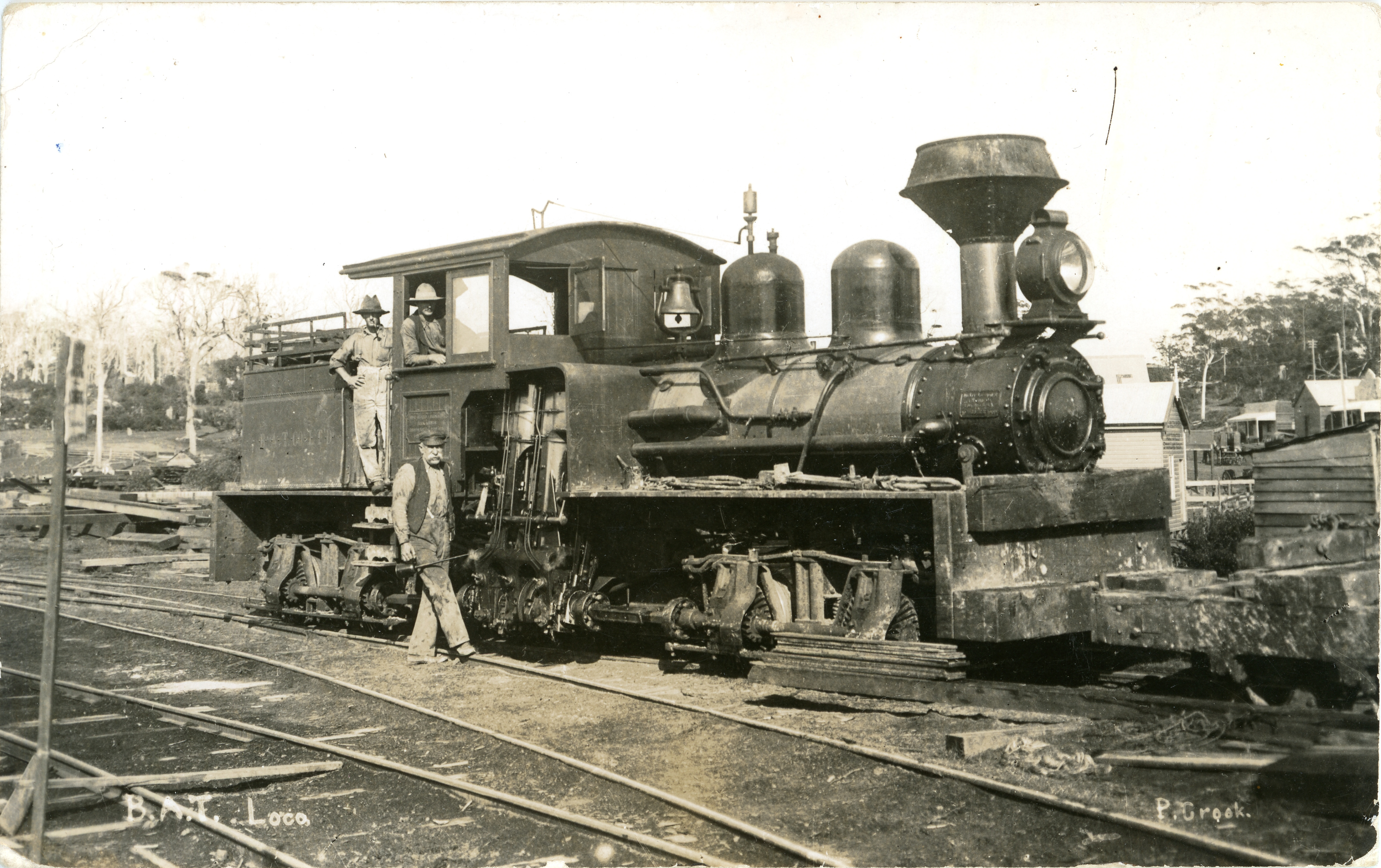
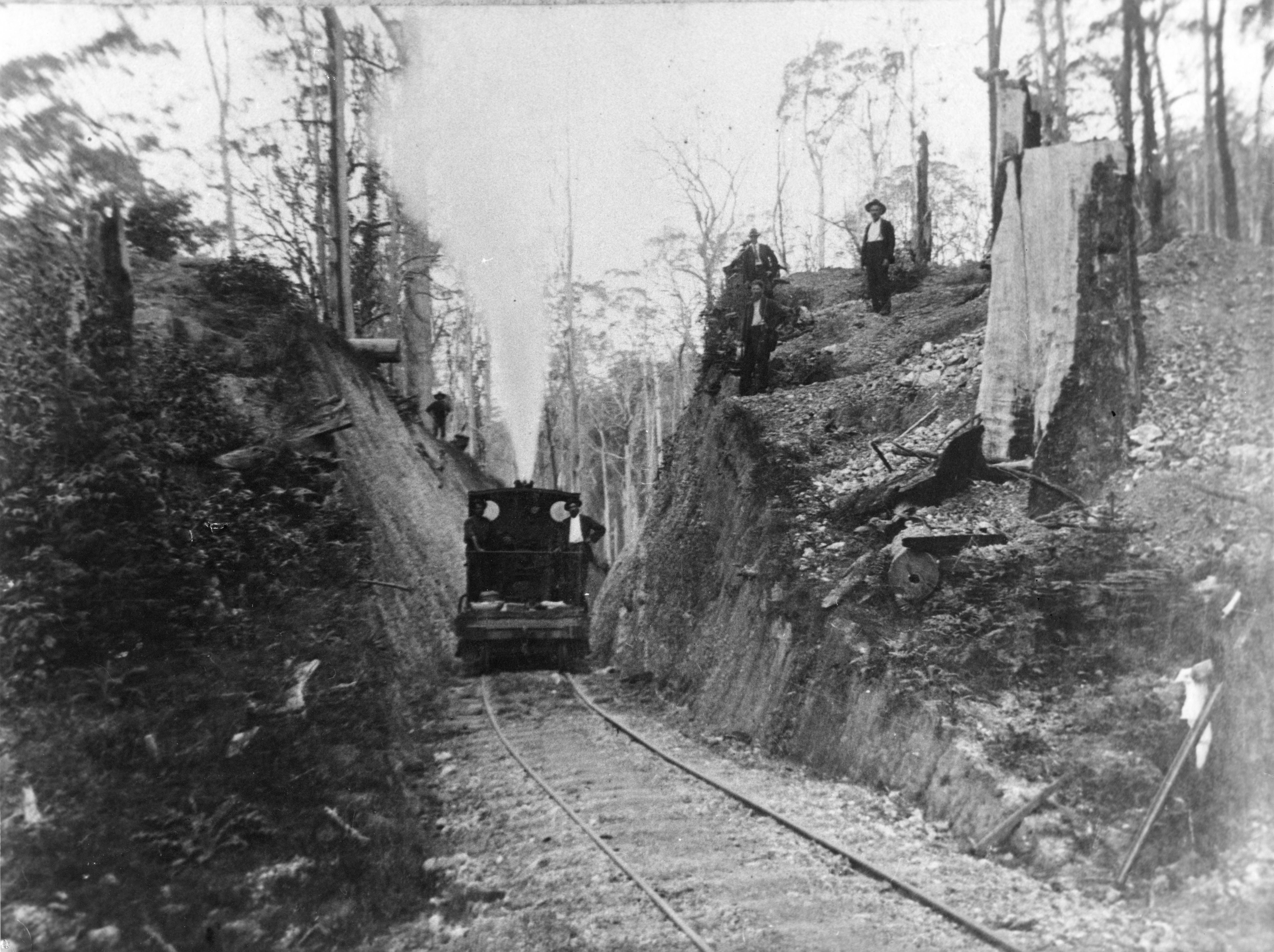
My early sport was shooting and exploring the bush on the hills behind the village. A lot of time was spent in the headwaters of Bucca Creek, now known as Bruxner Park. A tram line had been built in there from Coffs Harbour by the British Australian Timber Co., to obtain logs for their mill at Coffs Harbour Jetty.
The present road to Bucca Creek is built along the old tram track. Great heaps of logs were to be found at various points in the area, which had been felled and left, after the Company failed. These logs were the pick of the area, as only sound logs were wanted.
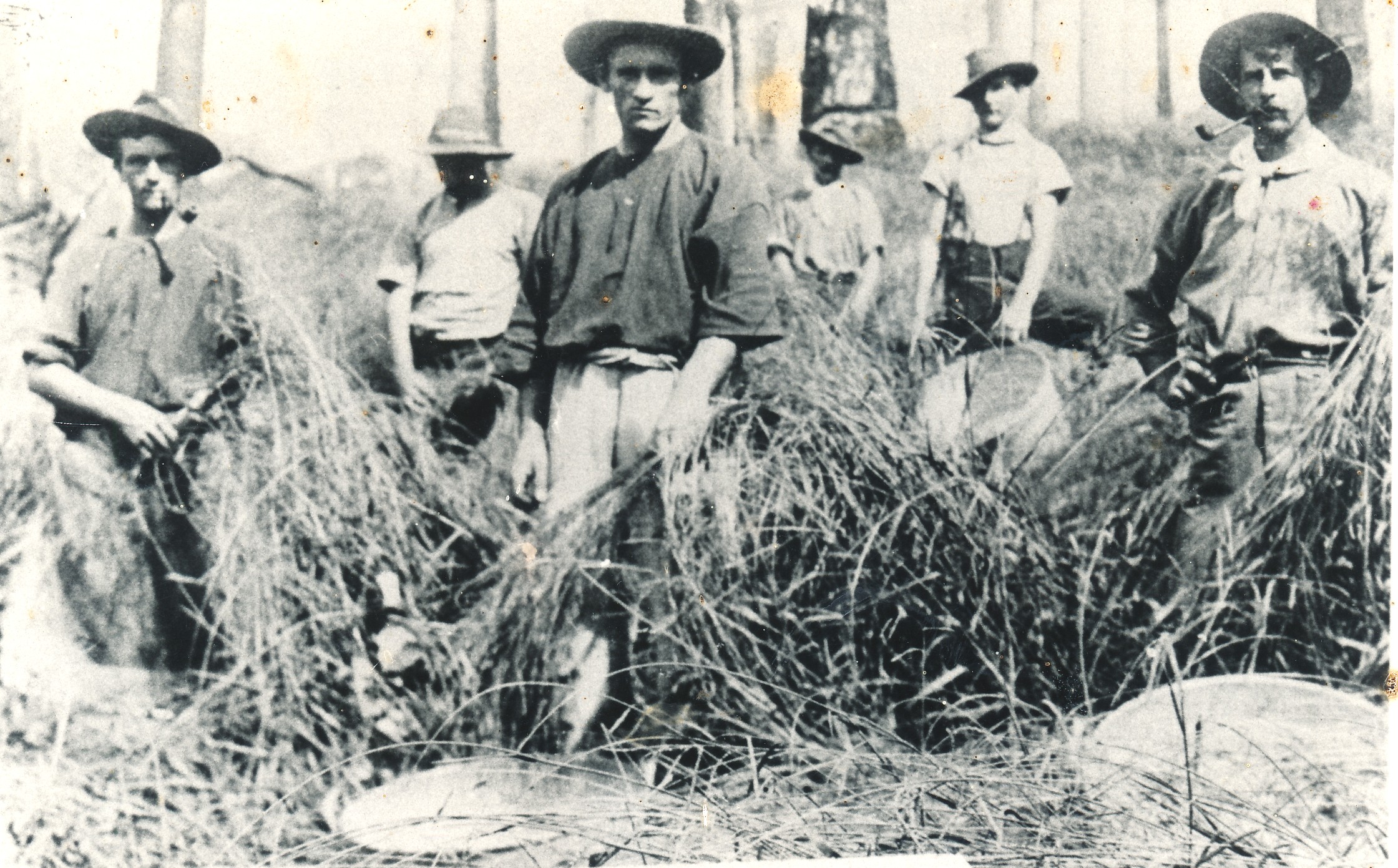
When the Railway Line came, and was fenced, the grass grew luxuriously inside the fence and went to seed. With an apron on, attached to a shallow dish or tub, the seed was hand-shaken into the dish. The seed was then sun dried, and sifted, before being sold to William Seccombe, who dubbed himself the “Paspalum King”. He had a very big business in exporting the seed to New Zealand.
Social Life
Dances were a big part of the Social Night Life, and parties were held in various homes and often in barns.
I went to one house party at a home where there were four girls in the family. On arrival we found that only men had been invited, assuring the resident girls of plenty of partners.
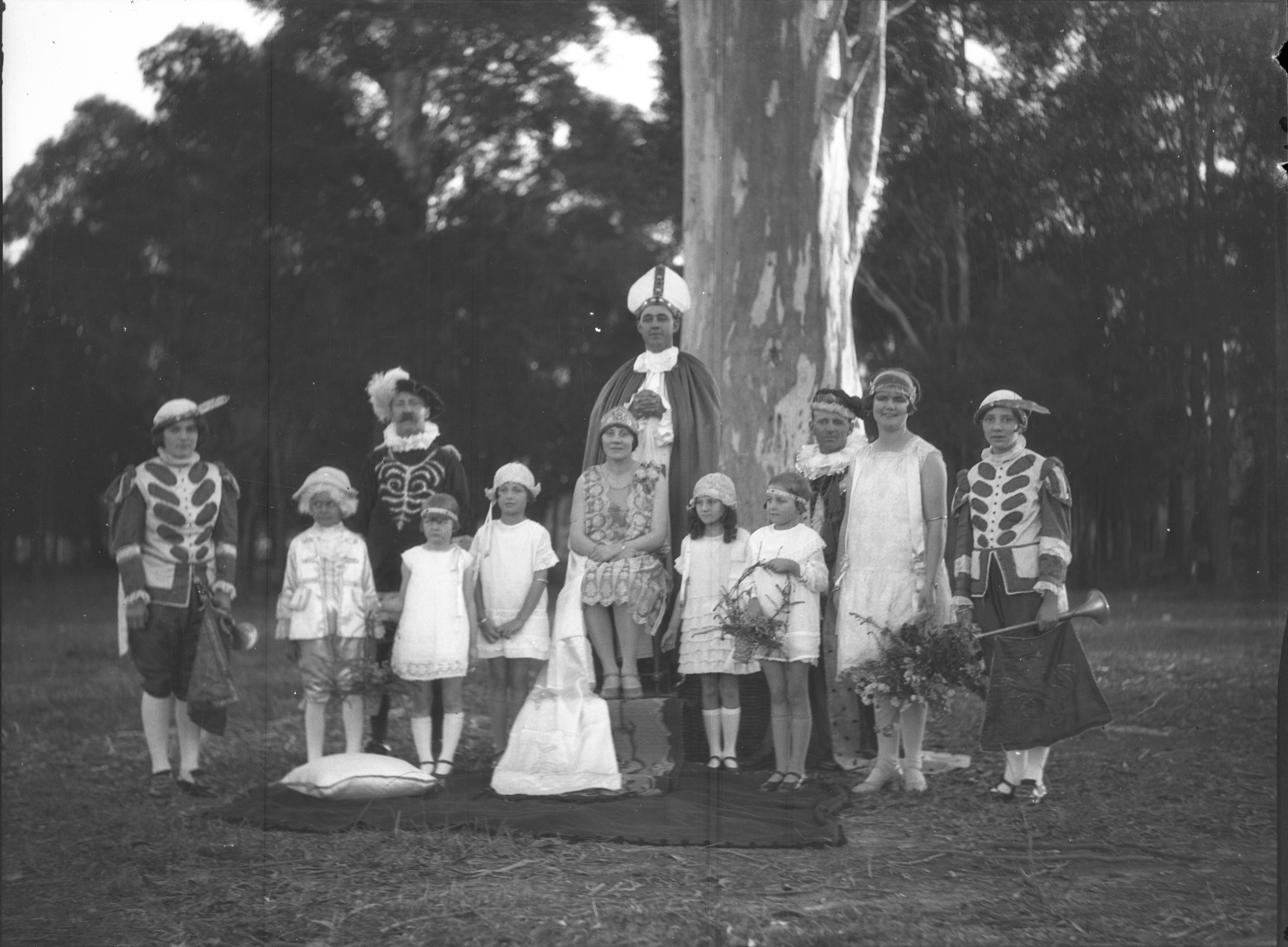
The music was mostly by accordion or concertina. Annual Balls held by different organisations were highlights. The annual Sports Ball at Upper Orara, held after the June sports at the Recreation Ground, with music by Hann and Pardoe from Grafton, was always a big event. With a sit-down supper with food supplied by the ladies of the area, all trying to outdo the others, was something to remember.
W N Small and keeping up to date before social media.
The name ‘Karangi t means ‘Black Duck! in the local aboriginal language. The name was given by Mr. W N Small, who was the Government Surveyor, who did the original survey of the whole of the Orara area. He was a very interesting man, who retired to a home which he called Inglewood, just up from the present Sport and Recreation Ground, at Upper Orara. As the butcher-boy, I arrived at his home about 11 0’clock three times a week, and I was obliged to have a cup of tea and provide Mr. Small with the latest local news, gleaned on my run. Mr. Small said that the whole area of the Orara was a vast scrub, and the only people he saw during his survey was an occasional cedar-getter. His brother, David Small, selected the area where the South and West Branch of the Orara converged. Another settler whom Mr. Small recommended to the area, was Amandus Hoschke.
Hunting
Our main game were Bush Turkeys and Flock Pigeons. This large, blue pigeon came each year to feed on the wild grape, and bangalow palm berries. On one trip in this area, we were witness to a mob of dingoes killing a black wallaby. Suddenly we heard a rush of ferns am small bushes being thrust aside, as the pack caught the wallaby in front of us. They immediately tore the wallaby to pieces. There were about 7 or 8 dingoes, so intent on their kill, they did not notice us. We were able to shoot two of the dogs. One was a big, black dingo, apparently a cross. This was a good days work for us, as a dingo scalp was worth £5 – todays $10. In later years, I was Dingo Destruction Board Agent for the area, and never disputed the colour of a scalp, having had personal experience, that a dingo could be any colour.
Railway
After the 1914-1918 War, there was quite a lot of unemployment, and the Government of the day, decided to finish the North Coast Railway Line. Most of the unemployed miners found work on the line. The contract for the line had been let to Norton Griffith. This firm folded up with only a portion of the work completed.
One of the biggest jobs was the five tunnels under the Red Hill. A big camp village was situated at the top of Red Hill, and a Post Office there was known as Coffs Heights. The Post Office was held by Mrs. Jack Pike, wife of well-known Jack Pike.
In the early days, the Mail Coach ran from Grafton to Bellingen. The mail from the Mines, which were in full swing about 1900, were brought by horseman from Bucca Creek to Karangi Post Office, where they were dispatched by Horse Coach. Later with the advent of the Motor Car, I think one of the first to have the contract was the Daniels family, who conducted the Family Hotel in Grafton, about where Gerards Department Store now stands. This continued until the advent of the Railway, which then carried the Mails.
There was a period during the building of the Red Hill tunnels, when the roads were very busy with the big Cadillacs of Robinsons Bros., who carried the Rail passengers between Wauchope, firstly, and then Macksville, as the line progressed up the Coast, and Grafton. The North Coast Line was completed in sections. The section between Glenreagh and Grafton was one of the first completed. The ballast for this line was brought by Tram Line from Glenugie Peak. The section from Coffs Harbour to Repton was also completed about this time, leaving gaps between Repton and Wauchope, and Coffs Harbour and Glenreagh.
Rum Story
One of Karangi’s most colourful sons was the late Alf 0’Neill. Later he established a small shop on the present site of the Post Office and Shop at Karangi. To supplement the business, he sold a few bottles of wine, rum, etc. This was against the law, and as was inevitable in a small community, it became known to the police. The police sent a plain clothes constable to the area, with the planned purpose to catch Alf. This constable got a job with a Mr. Branch, whose property was the other side from the shop on Poperaperan Creek. He posed as a pommy immigrant and often came to the shop. He caused much laughter when he used to mount his horse on the wrong side.
After gaining Alf’s confidence, he came down one morning, claiming a very bad stomach ache, and asked Alf could he sell him a bottle of rum, as this had helped him before. Alf fell for the trap and sold him a bottle of basket rum, which the constable paid for with a marked 10/- note [10 shillings or $1]. As soon as the deal was made, the Sergeant and constable, appeared on the scene, and arrested Alf for sly-grogging. The case was held at Coramba, and Alf was fined the enormous amount in those days, of £50. I don’t think Alf ever paid this.
Cousin Chart
So we have so many Hoschke cousins, can you tell your 2nd cousins from your first cousins once removed? Check out this handy cousin relationship chart from The Ancestor Hunt.
Facebook Group
We’ve created a facebook group, which is a lot more user friendly that the page settings and allows us to have better conversations there. Please help us out by joining and inviting your family members too, we’ve to meet new cousins!
https://www.facebook.com/groups/hoschkefamilyreunion
A Decade in Time 1940 – 1949
The 1930s were a decade of resilience, community spirit and generational change for the Hoschke family and the wider Orara Valley. Despite the hardships of the Depression years, the family remained deeply involved in local life through farming, timber work, education, public service and community events. The decade saw the younger generation achieve academic success, enter professional careers, marry and begin families of their own, while long-standing figures such as George, Annie and Ted Hoschke continued to play important roles within the district.
Fires, floods, illness and injury brought periodic hardship, yet the family’s strong ties to Upper Orara endured. By the close of the decade, George and Elizabeth Hoschke’s retirement to Coffs Harbour symbolised the gradual passing of responsibility from the pioneering generation to their children and grandchildren, just as the world stood on the brink of another global conflict.
1940
Mr. and Mrs. G. W. Hoschke, who recently left this centre to take up residence in their nice new residence, “Berwick,” Coffs Harbour, were pleasantly surprised to receive a presentation of an electric toaster from members of the Upper Orara P. C. Association in appreciation of long and valuable services to the P. & C. during their many years of residence here. Coffs Harbour Advocate
In June, Pte Norman Hoschke visited home for a few days while training at Ruthorford Camp. Coffs Harbour Advocate
Mrs. Baines (nee Miss Dot Hoschke) and family, of Newcastle, are holidaying with Miss Hoschke and Miss Davis at “Ferndale.” Coffs Harbour Advocate
Mr. E. T. Hoschke has sold his property and he and Mrs. Hoschke will be leaving the district shortly. They go to Laurieton, where they have purchased a property. Mr. Hoschke is a member of a well-known family here, and Mrs. Hoschke was a teacher at Upper Orara and Dairyville schools for a number of years. Daily Examiner
The community focus of the Hoschke family continued with mentions in local print media of their involvement in the Girls Friendly Society (Lena Hoschke), fundraising for the Upper Orara P&C (Arthur Hoschke, Frederick Hoschke & Norman Hoschke) and first aid classes (Annie Hoschke, A Davis)
1941
Mr. Colin Hoschke, of the Commercial Bank at Warialda, was married last Saturday at Tabulum, to Miss Edna Jones, of that centre. Colin, who is the youngest son of Mr. and Mrs. G. W. Hoschke, Coffs Harbour and formerly of Upper Orara, is well-known here. Coffs Harbour Advocate
PTE. C. F. HOSCHKE of Mayfield, who has been reported missing left Australia in January 1940, and took part in the Libya fighting. When his relatives heard from him last, about two months ago he was in Tobruk. They do not know when he was last in action, but think that it was probably in Greece. The Newcastle Sun
Mrs. G. Manson and son Douglas are holidaying in Sydney. Mr. N. Hoschke and Mr. Bruce Ide are visiting relatives at Tamworth and Warialda. Coffs Harbour Advocate
1942
The year began with wedding bells when St. Matthew’s Church, Holroyd, was the scene of a very pretty wedding on Saturday, January 3, when Muriel, only daughter of Mr. and Mrs. W. H. Lewis of Merrylands, was married to Les, younger son of Mr. and Mrs. Hoschke, of Greystaines.
In March, AC1 Norman Hoschke, RAAF, is spending short leave with his parents, Mr. and Mrs. G. Hoschke, at Coffs Harbour. He is accompanied by Miss Ilena Laing, daughter of Mr. and Mrs. A. Laing, late of Upper Orara, to whom he became engaged recently. Coffs Harbour Advocate
Miss Nancy Hoschke, of the lnfants’ Department of the Dubbo Primary School, on the eve of her departure on transfer to Peak Hill, was the recipient of a glass cut powder bowl and tray from the residents of Hopetoun Guest House. The presentation was made by Mrs Ted Hilton who stressed the deserved popularity of Miss Hoschke. Dubbo Dispatch
RAWARD.—September 9, at Women’s Intermediate Hospital, Brisbane, to Phyllis (nee Hoschke), wife of L.A.C. Raward, R.A.A.F.—a son (Neil Douglas). Sydney Morning Herald
1943
Hoschke (nee Lewis) June 22 at Hillcrest Harris Park to Mrs and Mrs Les Hoschke of Merrylands – a son Colin Leslie. Sydney Morning Herald
Noel, youngest son of Mr. and Mrs. Bill Hoschke, had a portion of the middle and fourth fingers of the left hand severed with an axe. After treatment at Coff’s Harbor Hospital he was allowed to return home. He is making satisfactory progress. Daily Examiner
WEDDING.
A wedding of considerable local interest took place at St. David’s Presbyterian Church, Haberfield. on July 10 last.’ The contracting parties were Cpl. Norman Hoschke, R.A.A.F., second son of Mr. and Mrs. G. Hoschke, of Coff’s Harbor, and Miss Ilena Laing, eldest daughter of Mr. and Mrs. A. Laing. of Sydney. Miss Laing who was given away by her father, favored a frock of stiffened net over taffeta, featuring a full circular skirt falling into a long train and trimmed with fan-like frills of the same material.
1944
Hoschke – August 16 at Wheatleigh Naremburn to Lieut & Mrs HC Hoschke – a son Brian Paul. Sydney Morning Herald
1945
The end of the war bought many stories of returning and recovering POW’s – Pte C E Hoschke was on the casualty list for recovered POW’s. There were many articles regarding the recovery and repatriation of released prisoners at the end of the war and one can only imagine the peace the community felt on their return.
In November of 1945 Ralph Ide & Arthur Hoschke were involved in the decision to cooperate with Karangi P&C Association in an effort to obtain free transport by bus to the high school for students from the Orara Valley. This would have opened up a lot of opportunities for education in general. Daily Examiner
1946
The year started with a sad passing, the death of Elizabeth Hoschke, wife of George William Hoschke in Coffs Harbour, NSW aged 66. It had earlier been reported that was seriously ill in Coffs Harbour District Hospital.
There was celebration at the marriage of Edith EM Tait and Irvine James Finucane at Wellington, NSW. Edith was the daughter of Mary & William Tait (nee Hoschke) and a granddaugther to Amandus and Mary. The birth of their son Peter was followed shortly afterwards by Edith’s tragic death at a young age. Death of Edith EM Finucane, daughter of Mary and William Tait in Wellington, NSW aged 28. Hoschke Family Reunion
Hoschke (nee Lillian Smee) – June 3 at Mater Hospital to Lieutenant and Mrs H C Hoschke, Lane Cove, a daughter Sandra Lynette. Sydney Morning Herald
A welcome home was extended to the returned men and women of the forces in the Orara Hall in Jun 1946. The hall was decorated and dancing, speeches and presentations were included in the program. Coffs Harbour had the proud record of the largest percentage of men enlisting in any part of the state according to Mr Claude Everingham, President of the Coffs Harbour branch of the RSL. Those honoured were Peter Coverdale, Jack Houlahan, Athol Manson, Bert Sinclair, Paul Quin, Alan Hunter, Cecil McDowell, Norman Hoschke, J Johnson, Leo McCann, Fred Herbert, Vic Stanlan & Mrs B Sinclair. Daily Examiner
Hoschke (nee Lewis) November 14 at Aloha Parramatta to Muriel and Les – a son Robert Henry Hoschke. Sydney Morning Herald
1947
Death of Henrietta Selina Hoschke, wife of Frank, in Coffs Harbour, NSW aged 68. It was reported that Coffs Harbour lost a valued resident and estimable citizen with her sudden passing from a stroke. Coffs Harbour Advocate
Hoschke – To Mr & Mrs C Hoschke (nee Miller) at Mater Hospital – a son David. Both well 10/12/1947 Newcastle Morning Herald
1948
1948 continued as the other years, many mentions of P&C involvement (Annie Hoschke, Arthur Hoschke, Ralph Ide), bowls competitions, CWA presentations (Annie), and visits home to family from those who had moved away.
1949
In the march of time, the much loved Coffs Harbour Orara Cooperative Dairy Society was coming to an end and in a show of respect the then 80 year old George William Hoschke was invited to chair the final meeting. This was in appreciation of his long and faithful service to the cooperative movement in the Orara and Coffs Harbour district. Coffs Harbour Advocate
I would like to note that we are heading into the territory of living descendants now and will take care when looking at coming decades to not share details but share general family updates.
Til next time!
Discover more from Hoschke Family in Australia
Subscribe to get the latest posts sent to your email.
