Please see the September 2026 Newsletter for an update on the article of the month regarding Amandus birth family!
Welcome to the August edition of our family newsletter. Spring is on the way and we look forward to warmer months. We would like to wish all of the fathers and father figures in our family a very happy Father’s Day for next weekend, hoping you spend time together with family.
 Article of the Month – Let’s start from 1676 – This month Ian takes us way back to the beginning of the Hoschke family, as far back as we have been able to research. We trace the Hoschke line down to two brothers, one who Amandus named as his father and the other who may have raised him as he called his son a brother, and his children nephew and niece and they visited and shared letters with Amandus’ family in Australia for at least two generations.
 Letter from Germany – Break out the tissues for this heartbreaking letter from Hans Hoschke in Germany provides a first-hand account of the family’s circumstances in post-WW2 Germany and illustrates how the Australian relatives helped sustain them during one of the hardest periods of their lives.
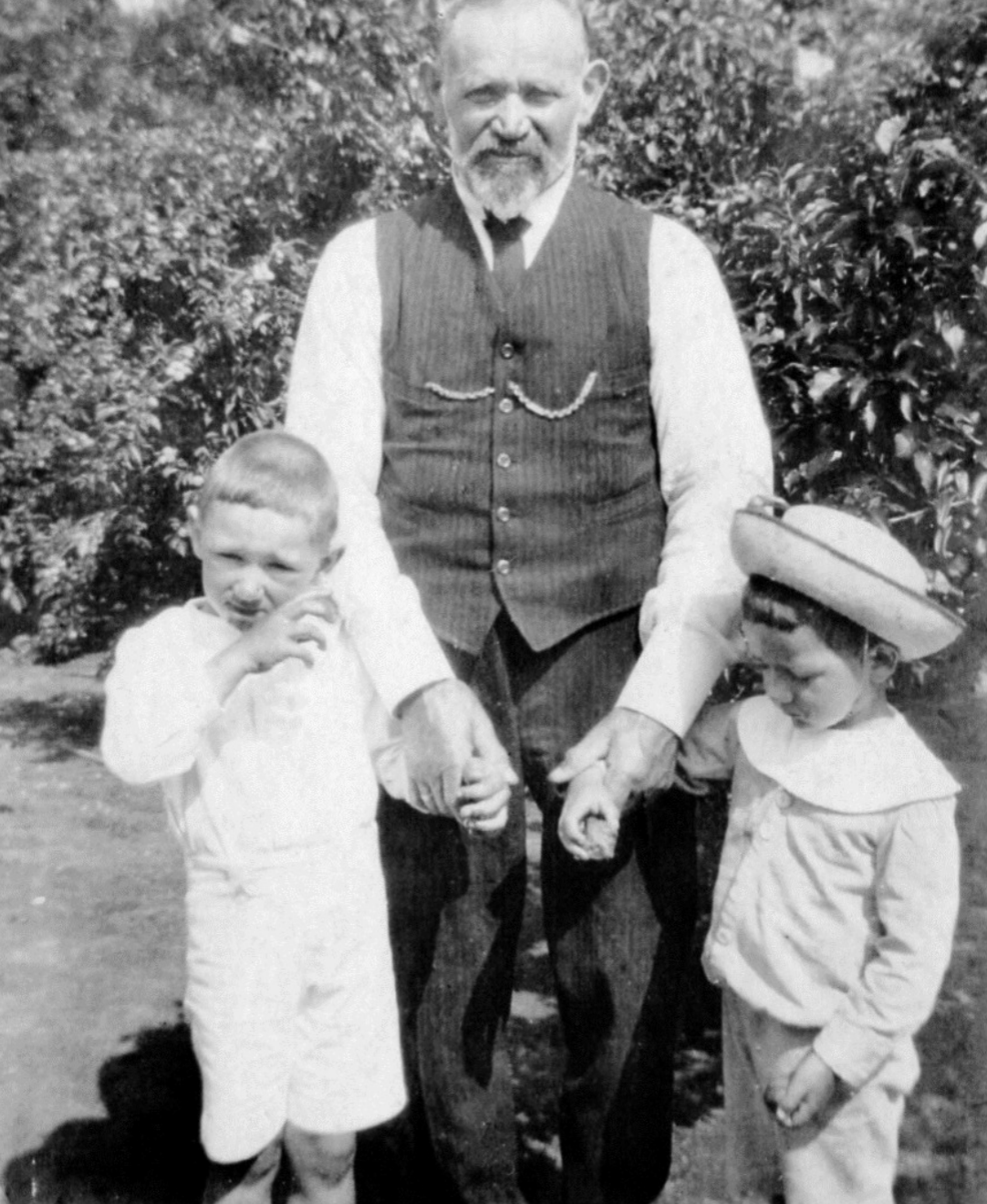
 Photo of the Month – in honour of Father’s Day this coming month we share a photo of Amandus with two of his grandsons, Jack and Norman.
 A Decade in Time 1970 – 1979
Article of the Month – Let’s start from 1676
The earliest we have traced the Hoschke line. Augustus Hoschke married Maria Rohde and their son Bernard Hoschke was born in 1676. They had two children and on it goes. The most relevant parts of the family tree are below, we have not included all of the children, just the ones relevant to our line.
This is pieced together from a number of sources and is as accurate as far as we can tell. Records were handwritten in Old German, often making them difficult to read and translate. Also, similar or same names could get mixed-up. There are anomalies, so questions remain. It is wonderful to find so much information, but it is only tantalisingly complete.
It is interesting to note that while the family lived in Sommerda some of them moved the almost 500km to Ueckermunde, which is a seaport not very far from Stettin (then in Germany but now Szczecin in Poland). Also, that the traditional family occupation was shoemaker. The names Amandus and Hulda occur amongst the family in Germany.
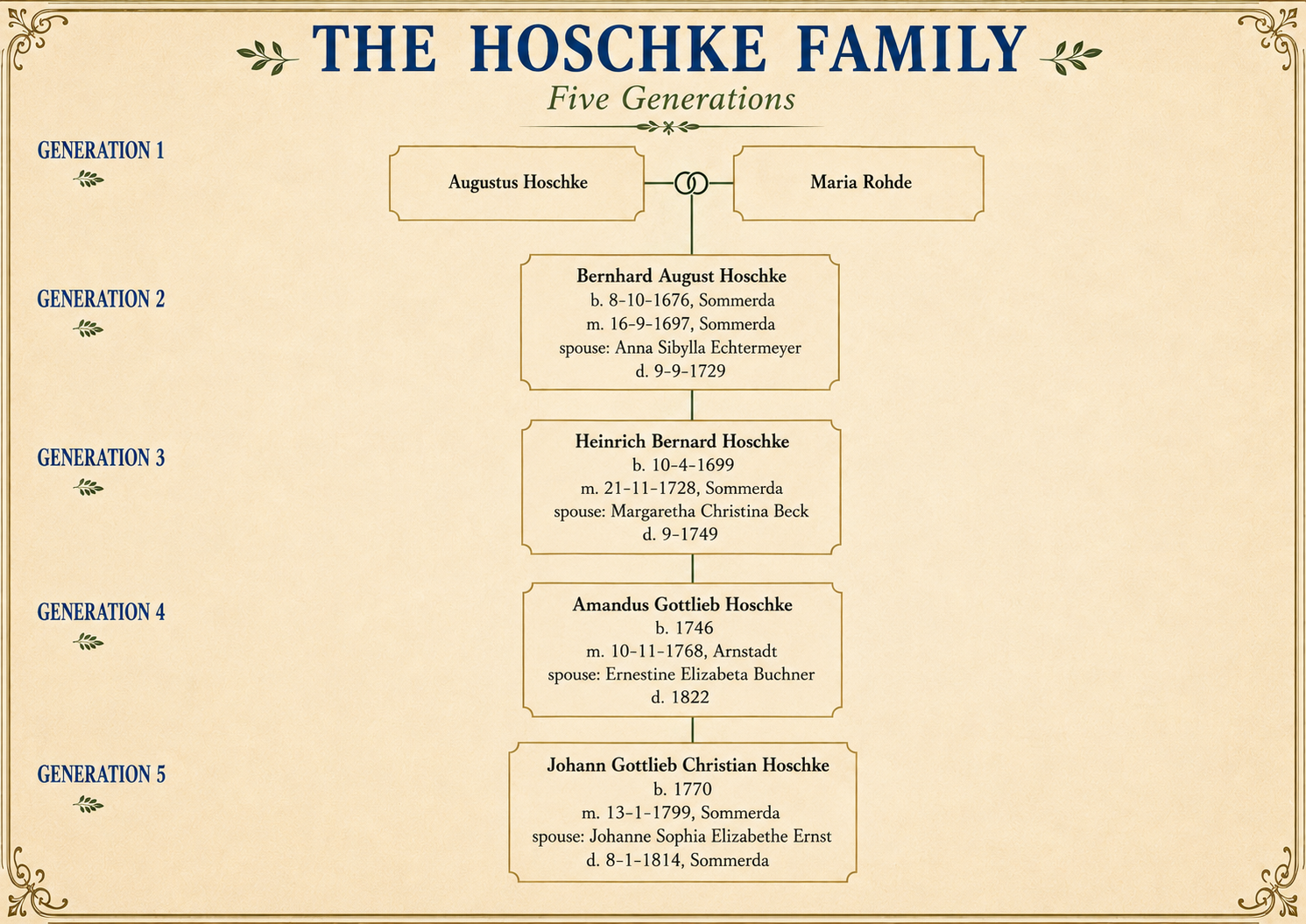
** Note that the following is only the relevant lineage so many siblings and their branches have been omitted.
Johann Gottlieb Christian Hoschke, was a shoemaker, and this is where it gets interesting, he and his wife Johanne had seven children (six boys and one girl) and of these we are interested in Johann Samuel Hoschke and Johann Martin Hoschke to understand the mystery of who Amandus’ parents were!
1 Amandus was the son of Johann Wilhelm Hoschke
Firstly, a son of Johann Samuel Hoschke was Johann Wilhelm and he had two daughters, one of whom was Hulda. Also, a son named Karl who may have been the brother of Amandus August Ludwig Hoschke (from here on abbreviated to AALH).
Supporting evidence for Amandus being Johann Wilhelm’s son and Karl’s brother includes:
- A postcard sent by Karl in 1898 refers to AALH as his brother.
- Photo of Lucie, wife of Karl, sent to AALH in 1906.
- Photo of Grete Budig, daughter of Hulda, with note referring to herself as a “distant niece”.
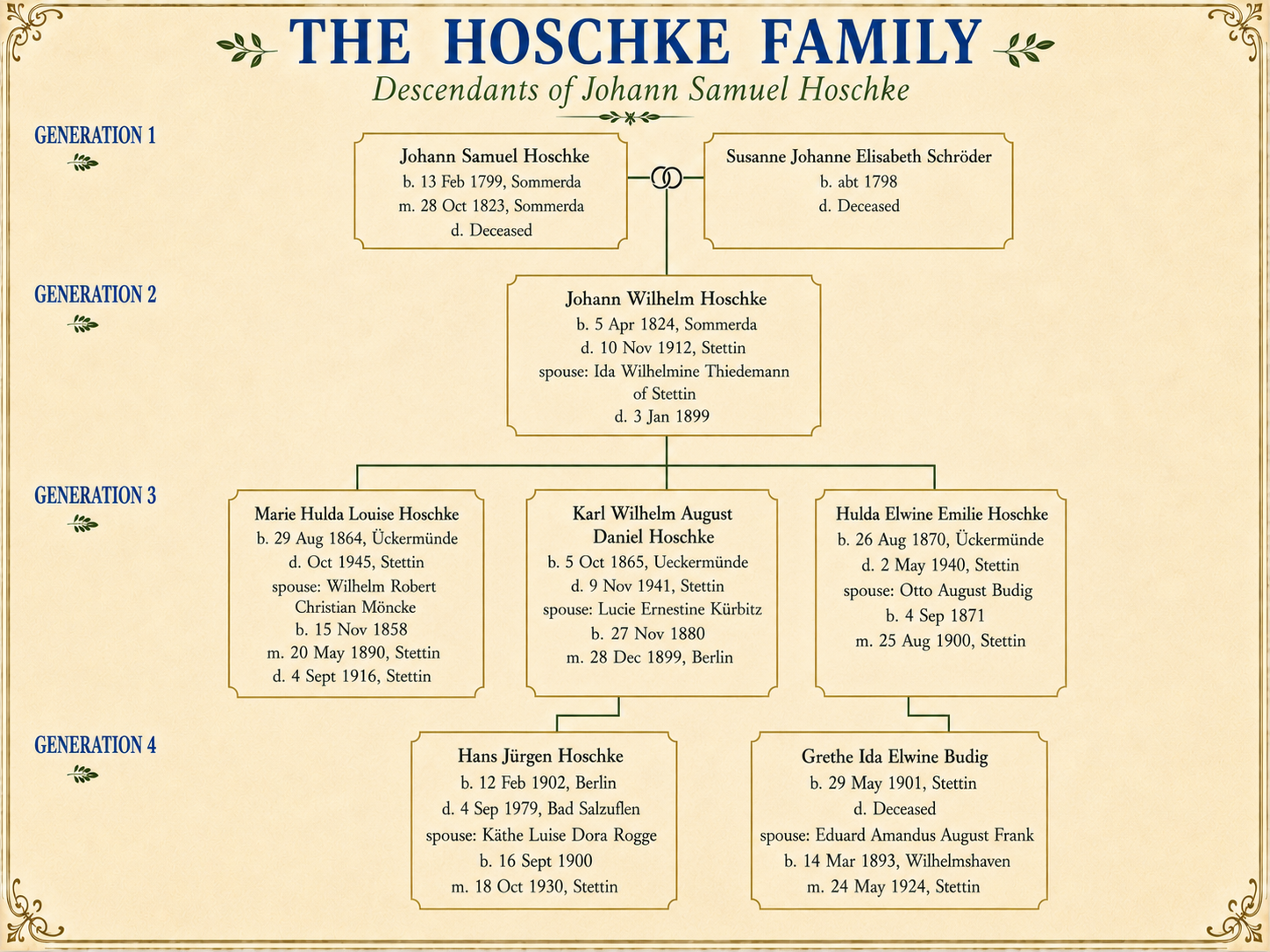
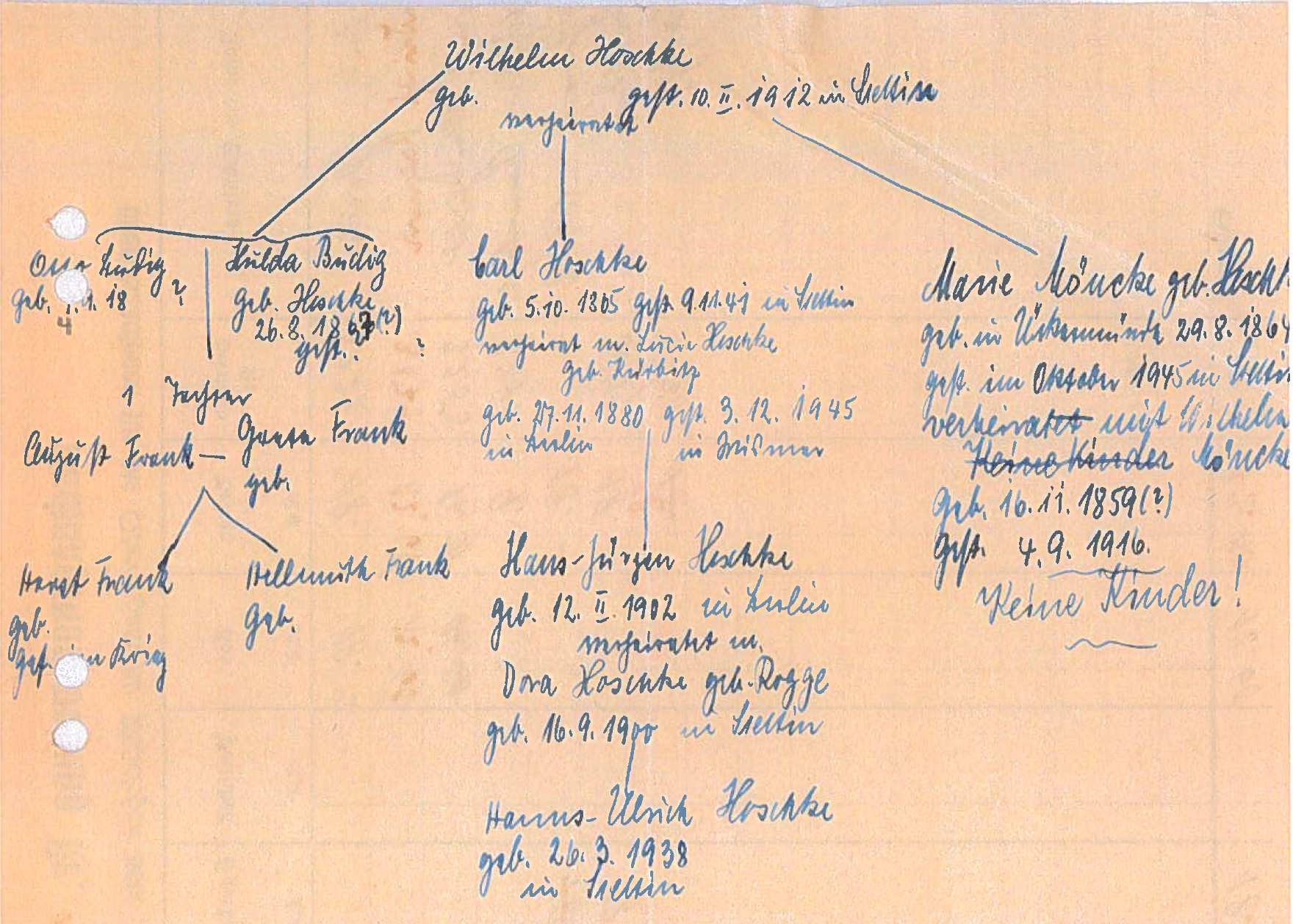
You can see all of these photos and read more here: Hoschke Family in Germany
2 Amandus was the brother of Johann Wilhelm Hoschke
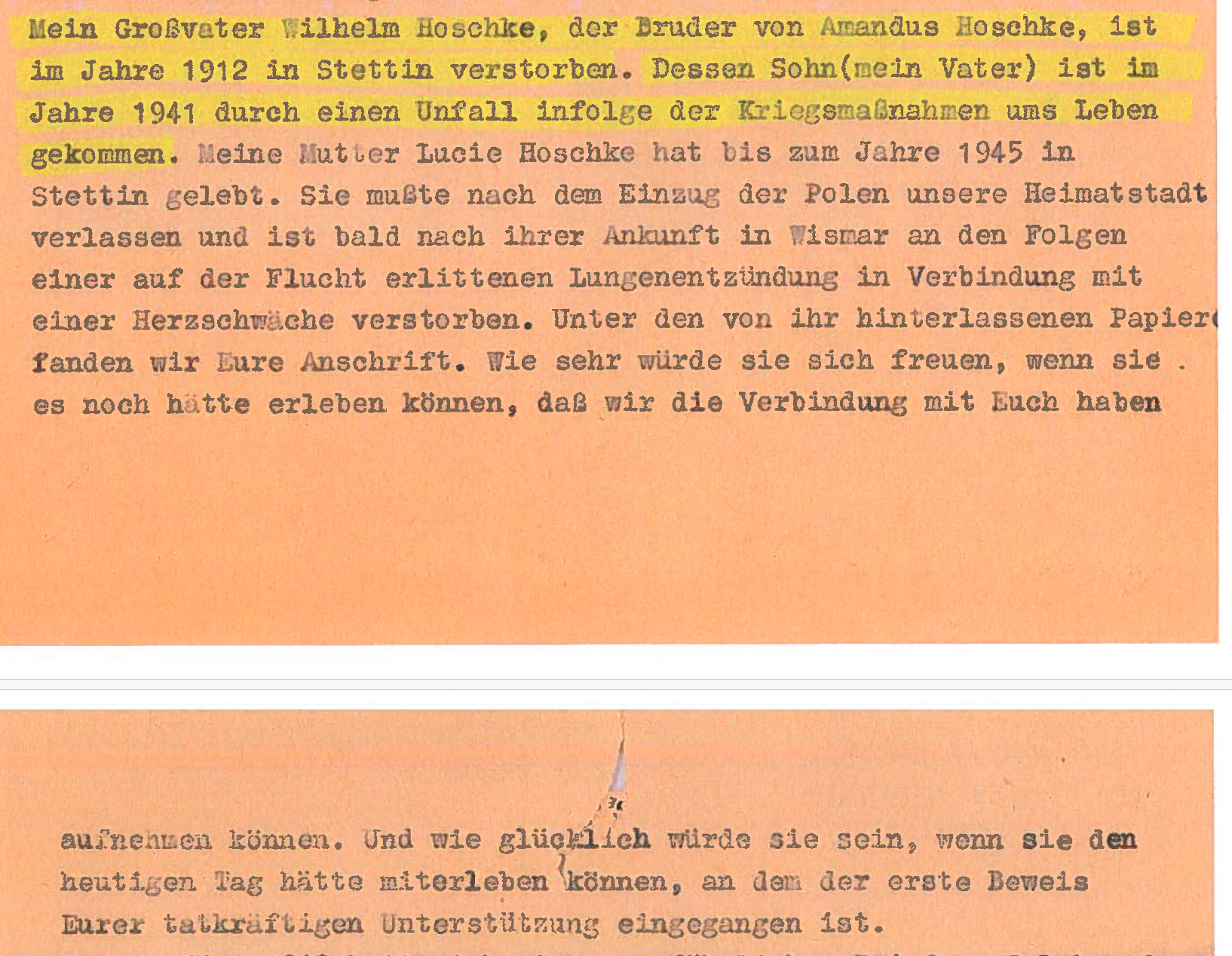
The second thoery is that Amandus may have been a brother to Johann Wilhelm Hoschke himself.
Supporting evidence for Amandus being Johann Wilhelm’s brother includes:
- in a letter Johann’s grandson Hans Ulrich Hoschke wrote to the Hoschke family in Australia dated May 1948, in which he explains the family connection thus:
3 Amandus was the son of Johann Martin Hoschke
Lastly, Johann Martin Hoschke, another son of Johann Gottlieb Hoschke, married Fredericka Thoms.
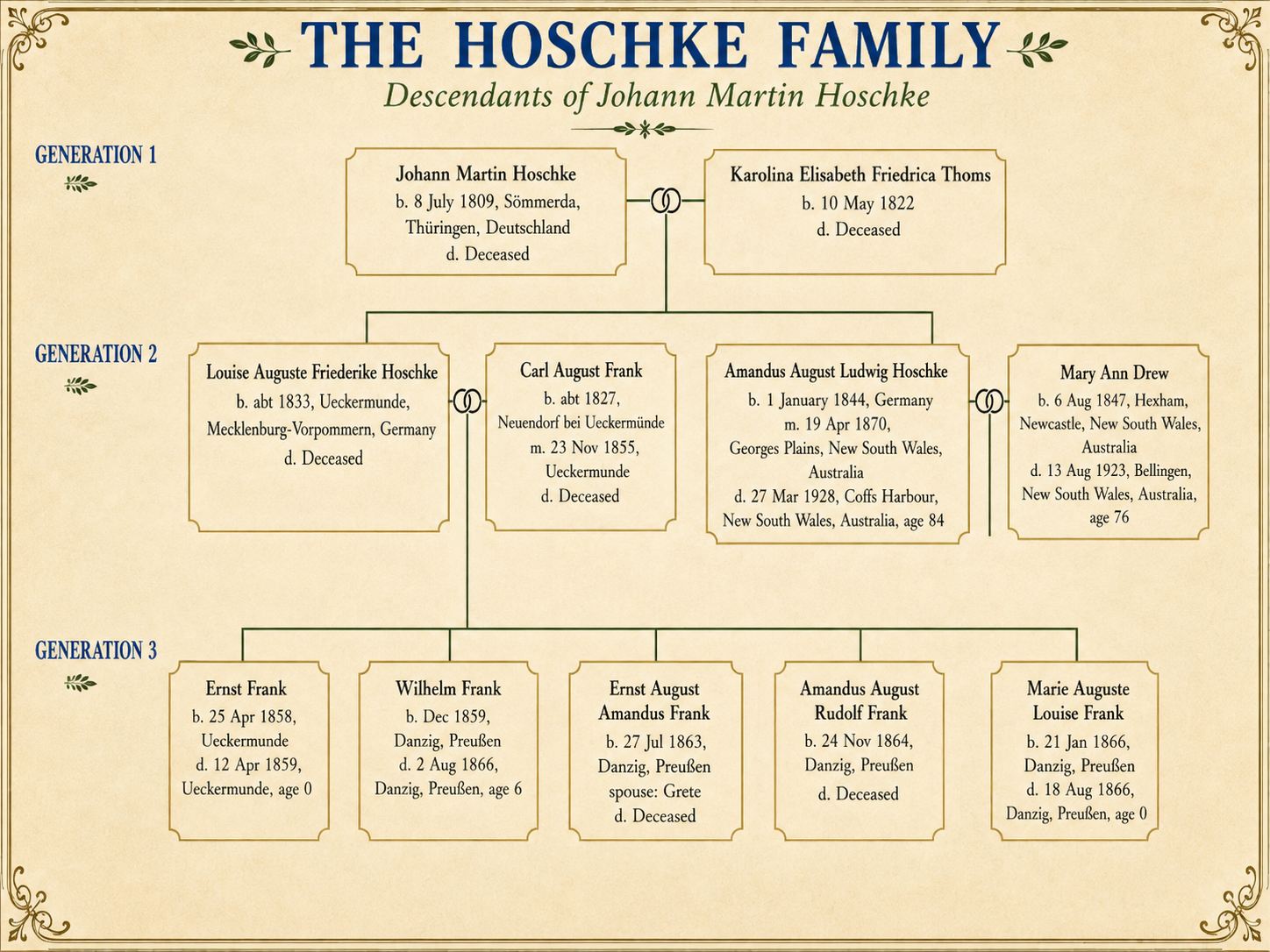
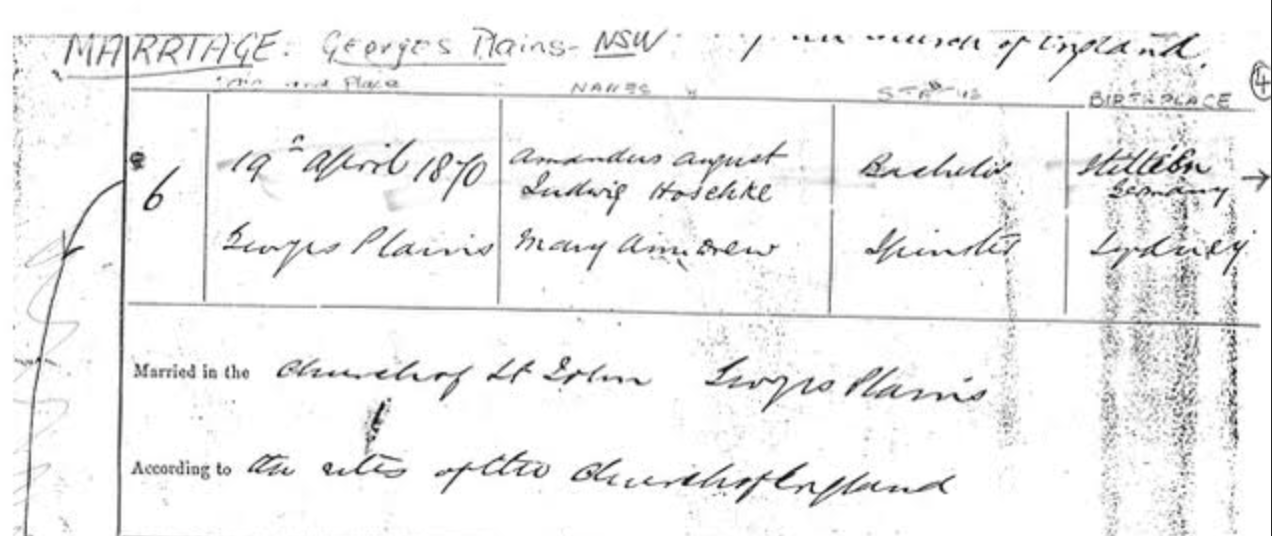
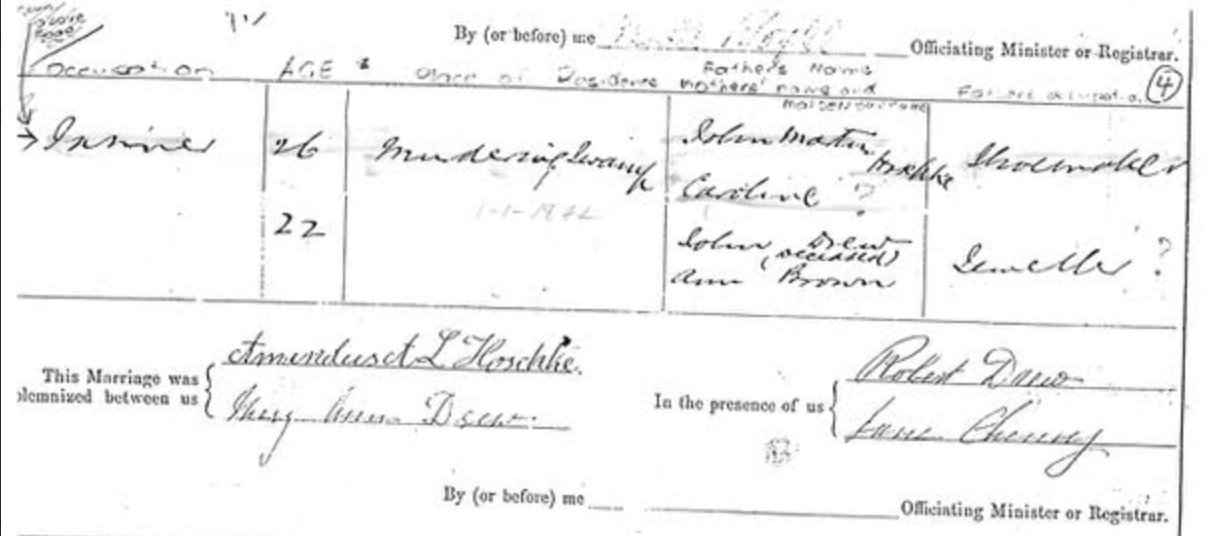
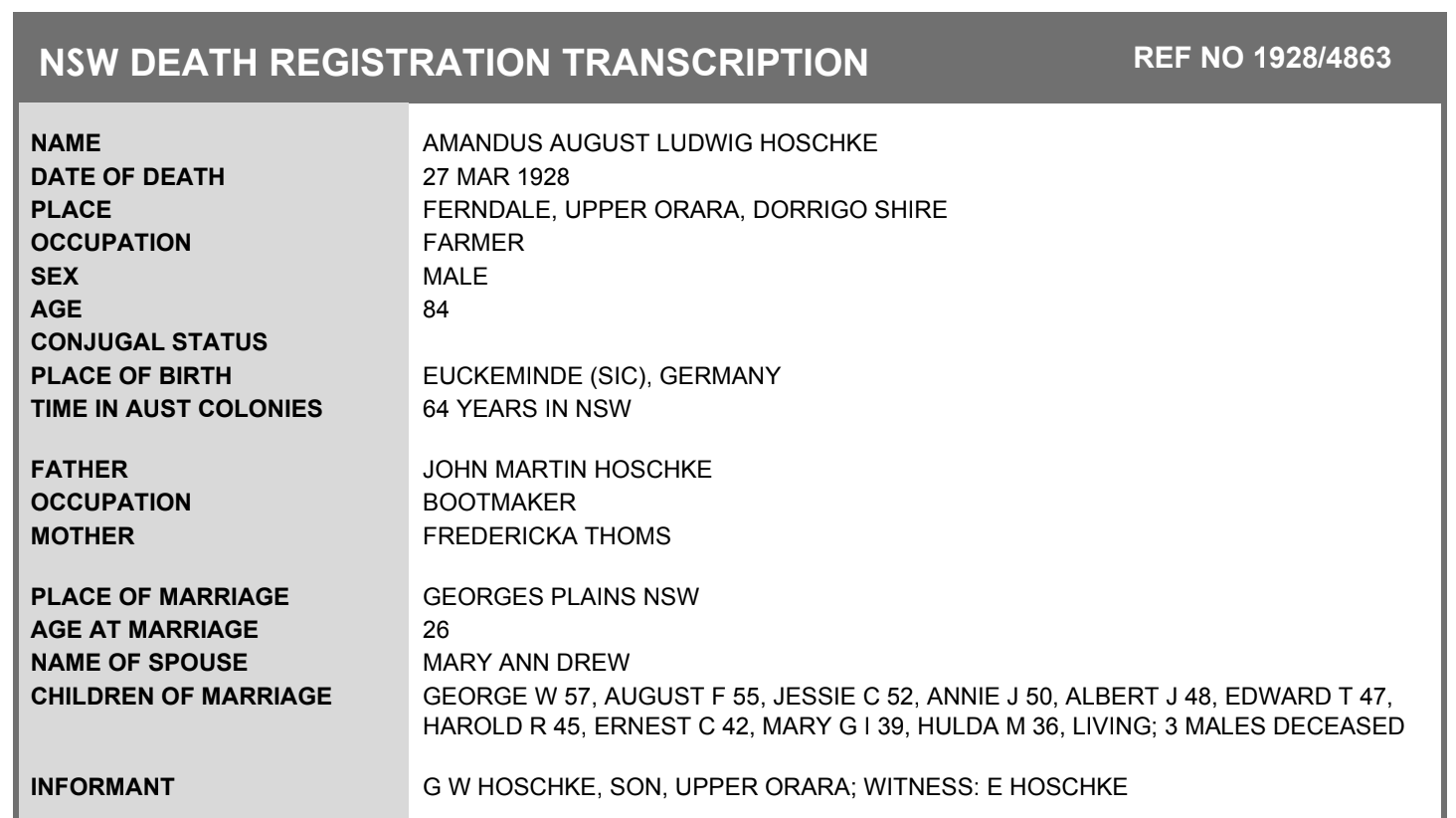
Supporting evidence for Amandus being Johann Martin’s son includes:
- Amandus and Mary’s marriage certificate lists his parents as John Martin & Caroline Hoschke
- Amandus death certificate confirms the same information.
Summary
- AALH was in communication with the family in Germany from 1898 to 1920, and possibly longer.
- He made a trip back to see them in 1905 by sea travel which would have been slow and expensive.
- Two branches of the family in Germany were in contact with the family here in the years just after WW2.
- One contact was from Dora, wife of Hans-Uhlrich who was the son of Hans Jurgen.
- The other contact was August Frank who visited Australia in 1912.
Unknowns / Anomalies
- If AALH was the son of Johann Martin, why was he eleven years older than his sister. Also, his birthdate of 1/1/1844 raises the doubt that he did not know the correct date.
- If AALH was the son of Johann Wilhelm how come he was 21 years older than his brother Karl.
- A possible explanation is that AALH was the biological son of Johann Martin but for some reason was raised by Johann Wilhelm, the father of Karl.
Either way, we have a rich connection to the Hoschke families back in Germany and have been fortunate enough to renew those connections in recent years with the descendants of Hans Ulrich Hoschke, who have shared with us letters they hold dear to their family that were received from Amandus and Mary’s children and grandchildren in Australia.
Letter from Germany
This letter is particularly moving. It was written by Hans Hoschke from Wismar, Mecklenburg (Russian Occupation Zone) in the difficult years following the Second World War. It is addressed to relatives in Australia who had been sending food parcels and letters, see the translation below:
Letter from Hans Hoschke
Hans Hoschke
Wismar, Mecklenburg
Schweriner Street 11
Russian Occupation Zone
Dear Relatives,
We hope you are not upset with us for only now getting back in touch with you. Our days pass so quickly with work and other obligations that we unfortunately do not always accomplish everything we intend to do. Besides, we do not wish to impose too often on the kindness of our interpreter, who, as we know, already has a great many letters to translate and answer. It hardly seems fair to burden her continually with our requests.
Now I shall report everything in order. Please pass this letter on to everyone who has thought of us so generously through both words and deeds.
At the beginning of March we received a lovely letter from Joyce, for which we thank her from the bottom of our hearts. She described your life and family circle so warmly that we could only regret that we cannot even visit you for a short time.
The news that the three parcels sent to us in December had been returned was naturally very disappointing. We still hope that conditions will improve so that they can eventually be sent again. We are sorry that this has caused you so much work, trouble, and expense. It saddens us that we cannot show our gratitude in any practical way.
You can surely imagine how difficult life has become—not only for us Hoschkes, but for everyone living in the countries devastated by the war. Many people who once lived comfortably were left after the war with nothing more than the clothes they were wearing.
That was our experience as well. Because the fighting swept through Stettin, we were able to bring almost nothing from our old home except what we could carry by hand.
You can hardly imagine the joy and excitement your letters and parcels have brought us every time they arrived. When we learned from Joyce’s letter, and later had it confirmed by Aunt Minnie’s letter to my wife, that the parcels had been returned, we were deeply discouraged. I can truly say that every sign of your affection has been a great celebration for us.
Then something wonderful happened.
On 21 March, the post finally arrived—although it had travelled by the long route through Sweden and Poland, which explains why it took so long. It was the first parcel sent by R. R. Ide, containing food, including a tin of pineapple jam. This parcel had been sent before the postal restrictions came into effect and had eventually reached us after its long journey.
But fate still had more good things in store for us. On 4 April, the postman proudly delivered four parcels at once. After unpacking them with the greatest excitement and amazement at the incredible blessings they contained, the whole room was filled with your gifts. How thoughtfully everything had been packed!
We have to thank:
- dear Aunt Annie for one parcel,
- dear Aunt Minnie for two parcels,
- and R. R. Ide for one parcel.
As far as we can tell, these four parcels had all been sent in November and had also travelled the long detour before reaching us. We were beside ourselves with happiness. First, all four parcels had arrived safely and almost completely undamaged. Second, they contained so many useful and wonderful things that benefited every one of us.
We were especially fortunate to receive a pair of small ladies’ shoes—probably from Joyce. By exchanging them we were able to obtain a pair of brown half-shoes that fitted Dora perfectly, so after five years she finally owned a new pair of shoes again.
The suit and the grey dress can be altered to fit. Little Ulli immediately proudly showed off his charming grey jacket and beautiful brown leather sandals to his playmates, who admired them greatly—and were quite envious.
I am also especially grateful for the writing paper and stationery Ralph included. I have not enjoyed something so fine and rare for many years.
Our heartfelt thanks for everything. How can we ever repay such kindness? Winter is now behind us. Thank God it was not quite as cold this year, and there was not too much snow. The days are growing longer again and the sun is beginning to warm us.
However, spring also brought many severe storms that caused considerable damage. Ralph asked whether we might obtain a garden or a piece of land. Here in the city it is very difficult.
Fortunately, through the previous tenant of our apartment—who returned two years ago to his old home in Frankfurt am Main, something that is no longer possible today—we were able to obtain a small plot of land beside the ruins of his house, which had burned down during the war.
That little plot helped us enormously last summer and allowed us to supplement our meagre food rations. Unfortunately, one cannot always enjoy the full harvest because the land is easily accessible and people who have not planted anything themselves are often tempted to harvest it.
But times will surely improve again, and these unpleasant experiences will pass. You asked in one of your letters about Aunt Hulda. Sadly, I must tell you that she died in Stettin about fourteen years ago. She had long suffered from heart disease. Because of her tireless diligence and constant care for her husband and daughter, she never allowed herself any rest. That was probably one reason why she died comparatively young. I have not seen her husband, Otto Budig, since 1943.
The war has torn so many families apart, and one often no longer knows where the others have gone. For example, we have been unable to learn anything about my mother’s sister, who was living in Eastern Pomerania in March 1945. Despite many enquiries and investigations through every possible authority, no information could be found. Because of the events of the war, she disappeared without a trace, and no one knows whether she is still alive or how her life ended.
In Aunt Hulda’s case one can almost say that she was spared all the horrors and suffering that the war later brought. The house in which Aunt Hulda had lived in Stettin was destroyed during the bombing, together with the entire neighbourhood, which was consumed by flames in a single night.
Anyone who has lived through such events never wishes to experience them again. Those who survived often have a far heavier burden to bear than those whom the Lord has granted eternal rest.
Please do not be upset with us for having been silent for so long. Once again, accept our heartfelt thanks, all of you dear relatives, young and old. Please write to us again soon.
With grateful hearts,
Yours,
Dora, Hans-Ulrich and Ulli
Photo of the Month
A Decade in Time – 1970 – 1979
The 1970s marked a period of transition for the descendants of Amandus and Mary Ann Hoschke. The pioneering generation was almost entirely gone, and the family was now well into its second, third and fourth generations. Family members were living not only around the Orara Valley and Coffs Harbour, but also in other parts of New South Wales and Queensland.
1970
The second last of Amandus and Mary’s children, Annie Hoschke, passed away aged 92. Annie had played an important role in the Upper Orara community. For many years she operated the Upper Orara Post Office from the Hoschke family home, Ferndale. She never married and remained in the old family home for the rest of her life. She was remembered for her service to the local community, her beautiful garden and the hospitality she extended to neighbours and family.
Hoschke grandson, Walter Frank Hoschke passed away on the Gold Coast, QLD at the age of 65. He left behind his wife Muriel and children Nola, Marjorie and Robin to mourn his loss.
1971
Hoschke grandson Ross Arthur John Ide passed away in May of 1971 aged 38. He is buried not far from his parents in the Methodist / Uniting section of the Coffs Harbour Historic Cemetery.
At the age of 89, the last of Amandus and Mary’s children, Ted – Edward Thomas Hoschke passed away in Taree, NSW. What an amazing life he led, from his war service during WW1, his huge contribution to community and family events, life long effects of an accidental gunshot injury and being an amazing gardener and farmer.
1972 / 1973
All Saints Upper Orara Women’s Guild re-elected the executive; President Mrs Sanders, vice-president Mrs JW Hoschke; secretary, Mrs. R. L. Watkin and treasurer, Mrs. R. R. Matton. – The Bananacoast Opinion
Hoschke grandson Keith William Hoschke, passed away in Mt Isa, QLD at the age of 35.
The Coffs Harbour Guides Plans are underway for the company camp to be held at the Hoschke’s Upper Orara property on December 7, 8 and 9. Sawtell Guides will also be camping on the site that weekend. Guides Gossip – The Bananacoast Opinion
As we can see adjacent, many years after Amandus’ passing, his estate was to be distributed after the passing of his daughter Annie.
Amandus’ will dated 6 September 1923 had read:
I GIVE AND BEQUEATH to my daughter ANNIE JANE HOSCHKE during her life the home and contents at present occupied by me also all rents and income from my farm at Upper Orara comprising portions 68 & 70 Parish of Coff’s County Fitzroy.
After her death the said farm to be sold and the proceeds to be equally divided between all my children in the event of the death of any of my children their portion to be paid to their children, if any.

1974
September 1974 started with a warning that a potentially explosive fire season was ahead in summer, Douglas Grahame Hoschke was Captain and Fire Permit Officer of the Upper Orara Volunteer Bush Fire Brigade. – Bananacoast Opinion
Later that month Doug’s attention was taken away by the sudden passing of his father Arthur Charles Hoschke at the age of 66. Funeral Notice Arthur left his wife Jean, mother Clunie, 5 sons and daughter-in-laws and 19 grandchildren.
Less than three months after Arthur’s passing, his mother Clunie Bain Hoschke nee Manson passed away in Coffs Harbour at the age of 90. Clunie had married Frederick in 1903 and had been part of the Hoschke family for more than seven decades.
Herbert Bruce “Bert” Davis, son of Jessie Caroline Hoschke and George Davis, died at Grafton Hospital aged 73. Bert was part of the Davis branch of the family descended from Amandus and Mary through their daughter Jessie.
1975
The Public Trustee will distribute the assets of the estate of Albert John Hoschke, known as Albert John Hiskins, other wise known as Herbert Hoskins, late of Baulkham Hills, N.S.W., pensioner, died 22nd January, 1939, intestate; an election to administer was filed on 26th August, 1975. NSW Government Gazette
Leslie Harold Hoschke, son of Harold Robert and Alice Hoschke. Les died in Blacktown, NSW, on 22 July 1975, aged 57. He had been a talented sportsman, including playing first-grade rugby league for Western Suburbs, and later became a successful lawn bowler.
1976
Prepare for the worst and hope for the best – That was the advice given by the Fire Control Officer for the upcoming season. A new shed had been built just south of the Orara Hall which would have been a great community asset. Doug Hoschke, as well as cousin Athol Manson continued to be involved in the volunteer bush fire brigade.
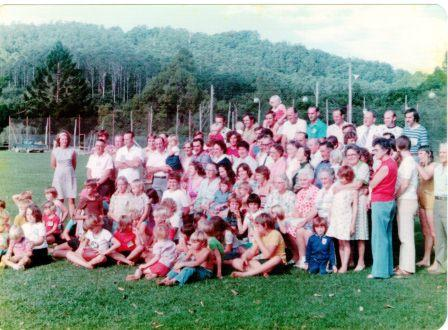
The 1976 reunion stands out as the major positive family event of the decade, bringing descendants together at a time when the family was becoming increasingly dispersed.
1977 / 1978
Margaret Hoschke, wife of Ted Hoschke passed away on March 31st, leaving her son Geoffrey, daughter in law June and grandson Paul to mourn her loss. Margaret had shared much of Ted’s life and had survived him by several years. Her death brought another chapter of the family’s early twentieth-century history to a close. The Canberra Times
1979
As 1979 drew to a close, the Hoschke family stood at another turning point. Almost one hundred years had passed since Amandus and Mary Ann Hoschke established their family in the Orara Valley, and the pioneering generation was now remembered through the stories, photographs and memories of their descendants. The family had grown far beyond the original thirteen children, with branches spread across Australia and several new generations carrying the Hoschke name forward. The family reunions, including the gathering in 1976, helped ensure that the connections between these increasingly scattered branches were not forgotten. As the 1980s approached, the story of the Hoschke family was no longer simply one of settlement and survival, but of preserving a shared heritage and passing it on to generations yet to come.
Discover more from Hoschke Family in Australia
Subscribe to get the latest posts sent to your email.

Oh wow….we have had some amazing assistance in the last few weeks that has blown some of the above theories out of the water! September newsletter might come early haha!
LikeLike