Welcome!
Welcome to our August 2025 newsletter! We have a bumper issue this month, including the mysterious Albert / Herbert Hoschke / Hoskins / Hiskins, our own family mystery! We also have a very special notebook which has been loaned to us to share with everyone.
- Albert John Hoschke
- Mary’s Notebook
- Photo of the month
- Coming soon – Amandus and the sea of stars
- This month in history
Article of the Month
Albert John Hoschke
Buckle up for the story of Albert John Hoschke who was born on 27 July 1879 in Bathurst, New South Wales, to Amandus August Ludwig Hoschke (aged 35) and Mary Ann Hoschke (aged 31). At eight years old, Albert and his family relocated to the lush, fertile Orara Valley, where he would spend much of his life.
In 1903, Albert, aged 23 was listed in the electoral roll as a farmer residing at Upper Orara.
By 1905, at the age of 25, Albert had firmly established himself in the region. That year, a massive 13,000 acres of crown land were released for sale or conditional lease—land coveted by many, including his brother Harold.
Demonstrating his determination and vision, Albert successfully secured 200 acres of prime farmland in a fiercely contested bid.
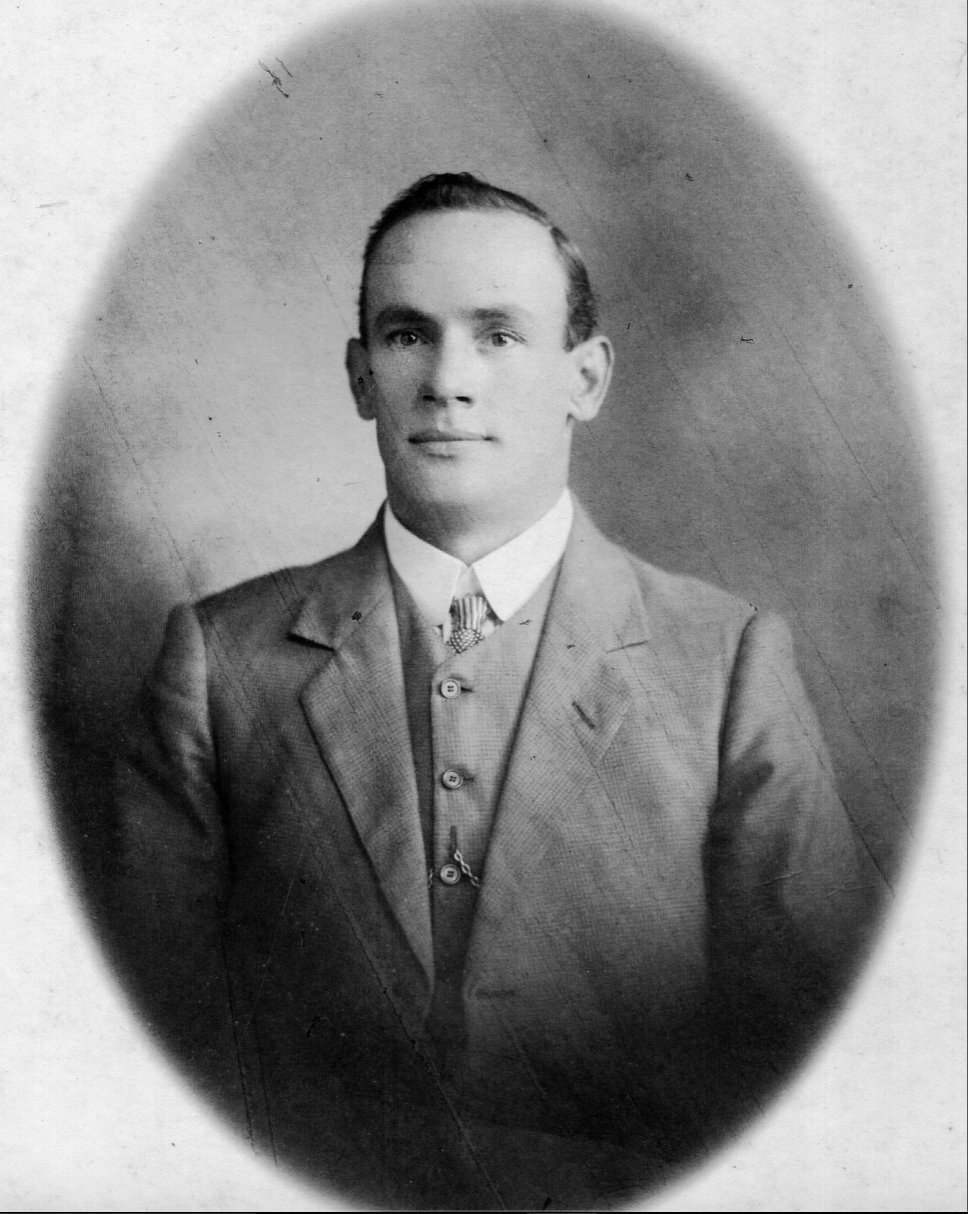
Albert’s youngest brother Arthur Henry Charles Hoschke as well as his sister in law Ruthetta Hoschke both tragically passed away in 1905.
1905 proved to be a pivotal year for Albert beyond acquiring land and the loss of family members. During a dramatic flood in the region, he risked his life to rescue two farmhands whose tent had been swept away by surging waters, an act of courage and quick thinking that became part of local history.
Clarence and Richmond Examiner (Grafton, NSW : 1889 – 1915), Tuesday 11 April 1905, page 5
The weather during the last fortnight , has been exceptionally wet, while on Sunday night (2nd inst.) the rain fell in torrents, and the river rose 10ft. in about four hours (this rise up here, means, about 15ft.
Two men, who were picking paspalum seed on Mr. N. Watkin’s farm, had a very unpleasant experience during Sunday night. It appears they were sleeping in a tent on the higher portion, of the low-lying land, and during the night were aroused by the roaring of the water in the river to find they were entirely surrounded, with the water already in their tent. However, they succeeded, by the aid of long sticks to feel the depth of water, in groping their way in the dark, and up to their chins in water, till they reached a fence, where they had to “roost” till morning, when they were found by Mr. Watkin, who, with the assistance of Mr. Albert Hoschke —who swam out to them with lines—succeeded in hauling them across the current to higher land, after an exposure of fully 10 hours. Mr. A. Hoschke deserves great credit for his great pluck in daring to swim across a current where but few men would attempt, and where he would not only for the purpose of saving life.
Life for Albert continued in the Coffs area, where he farmed and participated in the life and lore of the community. By 1913 he was living in Coffs Harbour and listed on the electoral roll as an agent. In 1915, at the age of 35, Albert enlisted in the Australian Imperial Forces at Liverpool, NSW. His service was cut short when he was discharged in August 1915 after a piece of timber fell and injured his ankle.

The 1920’s proved to be a sad time for Albert and the Hoschke family, he lost two brothers Amandus and Frederick along with his mother Mary in the space of three years. After this time Albert was residing in Sydney. There is mention of him returning to the valley to visit with his father Amandus in 1927, a year before he passed away.


Albert did not marry but there are photos of him with Nell Newbury and her family. We have not been able to find any further information on Nell or her family, but by the time Albert passed away he was living alone.
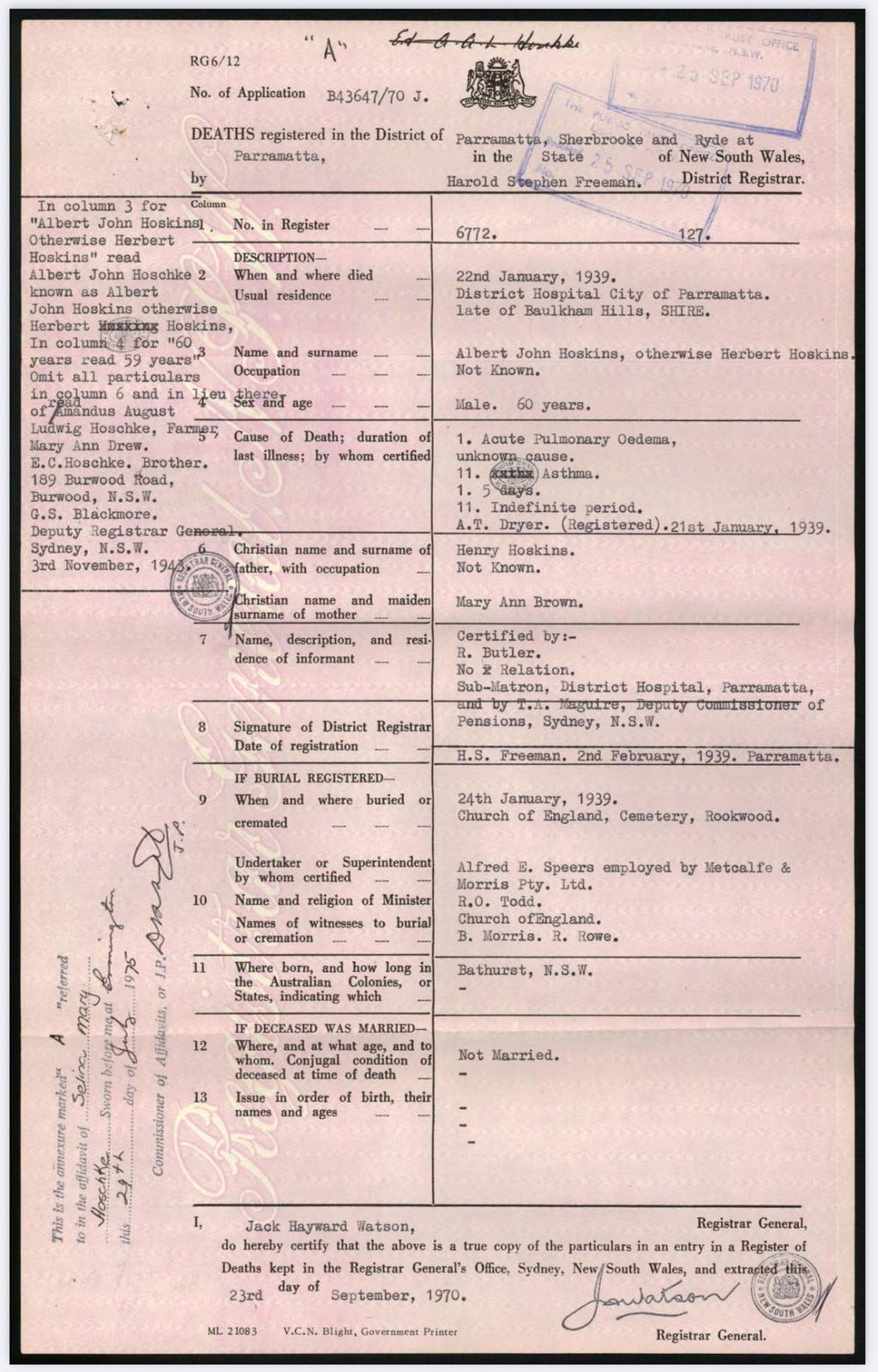
Albert passed away on 22 January 1939, at the age of 59. His probate notice, from many years later in 1975 was very interesting for a number of reasons. It lists Albert as a pensioner who had been living in Baulkham Hills and also mentioned several aliases that he was known by – Albert John Hiskins or Herbert Hoskins.
Albert’s probate includes a statutory declaration from his niece Selina Hoschke, which provides the sad conclusion to his story:
“I am a niece of the above named who died on the 22nd January, 1939, I am aware that my uncle Albert changed his name to Albert John Hoskins and Herbert Hoskins during World War I, as he thought it best not to have a German name where he was working. As he was known by the name of Hoskins from then on he kept that name.
I remember my aunt, the late Annie Jane Hoschke receiving word from my Uncle Albert’s landlady telling her of my uncle’s death and telephoning my father the late August Frank Hoschke that uncle Albert had died. The landlady could not find any will amongst his belongings.”
And with that Albert’s story has been told, however sad it is that he passed away alone under a different name, we are grateful to be able to tell his story here now and honour his memory.
Mary’s Notebook
With thanks to Pat and Darrell Davis we have been able to scan a precious treasure that has been handed down through their family. So very special to be able to share with everyone here, at least some of these names are written by Mary, perhaps some added by her daughters as well. Did your mum have a birthday book that has been handed down?
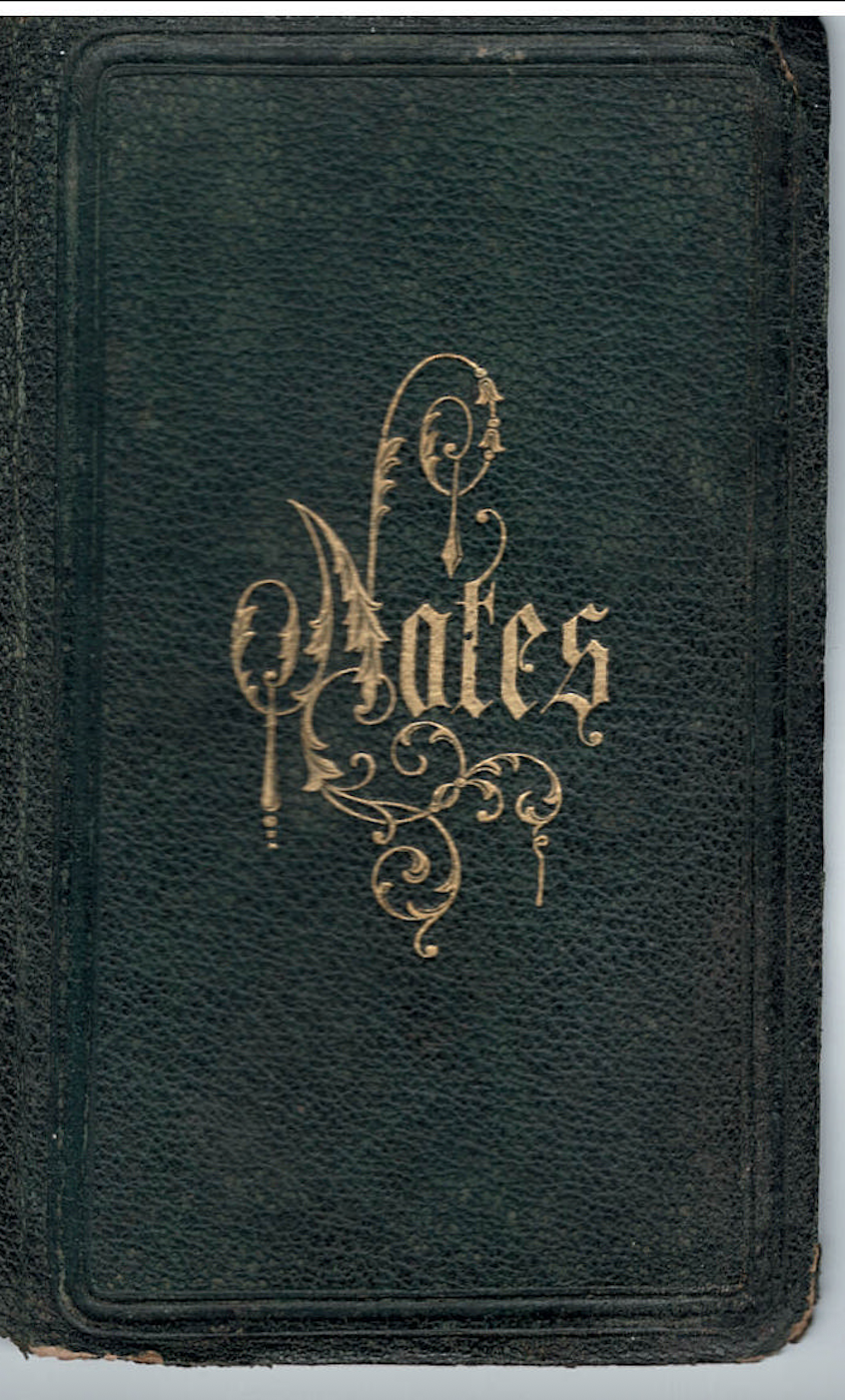


Photo of the Month
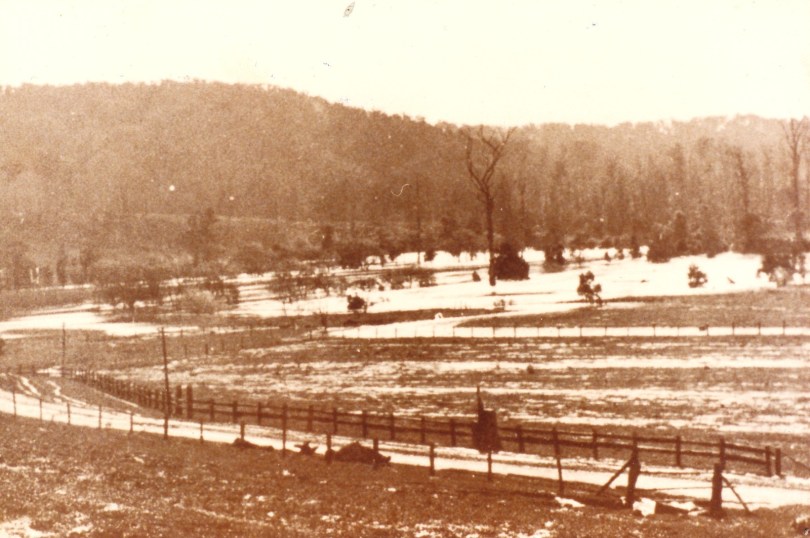
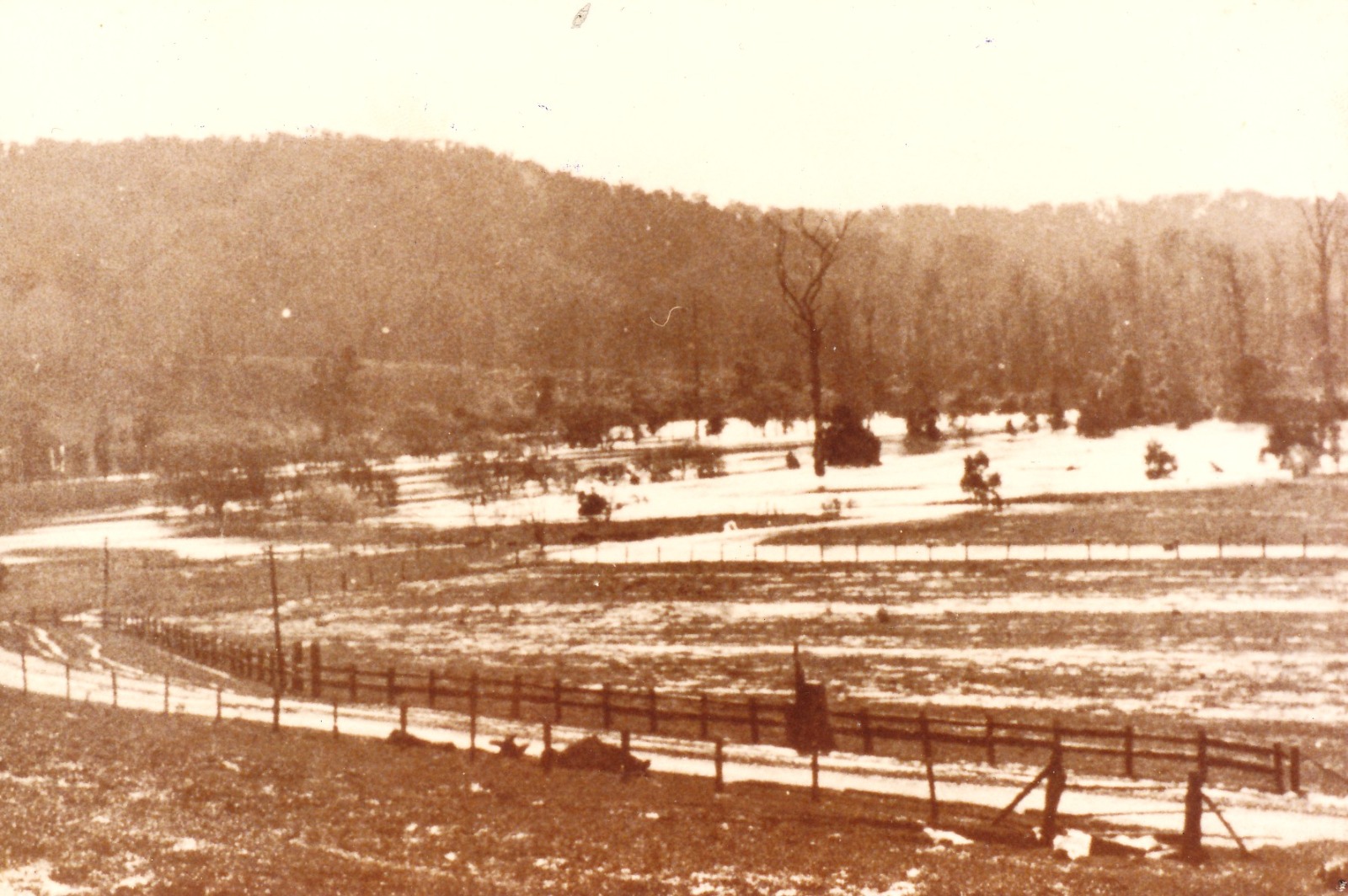
This month’s undated photo is looking west of the Recreation Ground at Orara. If you have been to the Orara Valley Fair, you may have parked in this paddock, but under flood it looks so very different!
The story of the Hoschke family in the Orara Valley is deeply entwined with the ever-changing moods of the Orara River. From the very first night Amandus and Mary moved into their new home—only to be met by floodwaters—the river has shaped their journey. We remember Albert’s act of bravery during the flood of 1905 and the heartbreaking loss of Frederick Amandus Hoschke to the flooded waters of Wongiwomble Creek in 1922.
These moments echo a broader truth: for the early settlers, the river was both a life-giver and a threat. It provided essential water for irrigation, household use, and washing clothes. It was a place of joy too—where children and adults alike sought relief from the heat on sweltering summer days. Looking back through faded photographs and old newspaper clippings, it’s hard to grasp just how vital the river was to everyday life. But its rhythms—rising and falling—have quietly told the story of survival, community, and connection in the Orara Valley.
Amandus and the sea of stars
In coming months we are continuing to finalise a children’s story about Amandus’ journey to Australia. It will be available for download and we hope will be a way of engaging our younger Hoschke’s with their family stories.
This Month in History
During August, we remember these family members with love:
1 Aug – Amandus Ludwig Hoschke born in 1884
2 Aug – John William Hoschke & Phyllis Jean Garlick married in 1939
4 Aug – George Edward Victor Hodgson passed away in 1984
5 Aug – Edna ‘Teddie’ Jones passed away in 2005
5 Aug – George Edward Hoschke passed away in 1956
6 Aug – Elma Minnie Davis (nee Hofmeier) born in 1910
6 Aug – Mary Ann Hoschke (nee Drew) born in 1847
8 Aug – Nellie Enid Murray (nee Hoschke) passed away in 1975
11 Aug – Irving James Finucane born in 1897
12 Aug – Dulcie Jean Sonter passed away in 1950
13 Aug – Mary Ann Hoschke (nee Drew) passed away in 1923
15 Aug – Arthur George Davis born in 1908
17 Aug – Clunie Bain Manson born in 1884
18 Aug – William Frederick Hoschke & Dulcie Jean Sonter married in 1937
21 Aug – Eric Gunning born in 1919
25 Aug – Nancy Evelyn Hoschke born in 1921
26 Aug – August Frank Hoschke passed away in 1964
26 Aug – June Isabell Hoschke passed away in 2002
27 Aug – Edward Thomas Hoschke passed away in 1971
28 Aug – Norman Frank Hoschke passed away in 2013
29 Aug – Annie Jane Hoschke born in 1877
31 Aug – Arthur George Davis passed away in 1988
Til next month!
